🚨 The golden rule: NEVER pay for a product you haven't seen in person and tested yourself. No deposit, no advance, no wire transfer. If someone asks for money before you have the product in hand — it's a scam.
Table of Contents
Every year, thousands of Canadians fall victim to scams when buying online or through fake garage sale listings. Fraudsters are increasingly sophisticated: beautiful photos, tempting prices, a sense of urgency — they know exactly how to exploit your enthusiasm and impatience. This guide teaches you to recognize their tactics and protect yourself effectively.
The golden rule: see, test, then pay
This is the most important piece of advice in this article — and probably the only one you truly need:
The 3 Absolute Rules of the Smart Buyer
NEVER pay before seeing the product in person
No deposit, no advance, no wire transfer "to hold it." An honest seller will understand that you want to see the item before paying.
NEVER pay before testing the product
An appliance, a tool, an electronic device — plug it in, turn it on, try it out. If the seller refuses to let you test it, walk away immediately.
NEVER buy a "garage sale" product remotely
A real garage sale happens in person, at the seller's home. If you're asked to pay online for a "garage sale" item, it's fraudulent.
These three rules are simple, but they're enough to protect you from the vast majority of scams. Fraudsters rely on your fear of missing out on a deal to push you into paying without checking. Don't fall for it.
The most common scams
Here are the most frequent schemes we see in Quebec, both for garage sales and online transactions:
The fake online garage sale
The scammer posts an enticing ad on social media or Marketplace with beautiful photos of items at bargain prices. But there is no garage sale — the photos are stolen or staged. They request payment to "reserve" items before the "sale."
💡 How to spot it: No specific address given, advance payment required, photos too professional for a simple garage sale.
The "hold it" deposit
"Someone else wants to buy it, but if you send a $50 deposit now, I'll hold it for you." This is the classic scam. Once the money is sent, the seller vanishes or the product simply doesn't exist.
💡 How to spot it: Pressure to pay immediately, must send an e-transfer or gift card, refusal to show you the product before payment.
The hidden defect
The seller offers an item that looks perfect but has a hidden defect. Examples: a phone whose battery dies after 30 minutes, a dishwasher that leaks, a laptop with a failing hard drive. The seller is counting on you not testing thoroughly on the spot.
💡 How to spot it: The seller is in a hurry, refuses to plug in or start the device, "the battery is just dead," "I don't have an outlet here."
The inflated original price
"This furniture is worth $2,000 new — I'm letting it go for just $400!" The scammer inflates the original value so their price seems like an incredible deal. In reality, the product may be worth $100 used or even counterfeit.
💡 How to spot it: Always check the actual value of the product online before buying. Compare prices across multiple sites.
Stolen goods
Items sold well below market value at garage sales or online may be stolen property. Buying stolen goods is illegal in Canada, even if you didn't know they were stolen.
💡 How to spot it: Abnormally low price for a valuable item, nervous or hurried seller, no original receipt, refusal to provide contact information.
Psychological tactics scammers use
Fraudsters don't just rely on lies — they exploit human psychology. Here are the most common manipulation techniques:
timer Artificial urgency
"Hurry up, someone else is coming to pick it up today!"
"My listing expires tonight, it's now or never."
Reality: An honest seller will never put artificial time pressure on you. If the product is truly good, it can wait until you come see it.
sentiment_satisfied Fake sympathy
"I'm moving urgently, that's why the price is so low."
"It's to help my sick mother, I need the money fast."
Reality: Emotional stories are designed to bypass your rational judgment. Stay factual: see the product, test it, then decide.
sell Too-good prices
"iPhone 15 Pro Max for $200, like new!"
"MacBook Pro for $300, need to get rid of it today."
Reality: If the price seems too good to be true, it probably is. Nobody sells a valuable product at a fraction of its price without a shady reason.
photo_camera Misleading photos
Catalog photos, images found on Google, professional staging.
The actual product looks nothing like what was advertised.
Reality: Ask for additional photos with a specific detail (your name on a piece of paper beside it, or a specific angle you request). A real seller will comply without issue.
Online "garage sales": the perfect trap
The very concept of an "online garage sale" should trigger your fraud radar. By definition, a garage sale is a physical, in-person event where you can see and touch the products. When someone tries to sell you a "garage sale" item without letting you see it, there's a problem.
⚠️ Warning — online platforms don't verify sellers
Facebook Marketplace, Kijiji, Craigslist, and similar platforms don't guarantee seller identity or product quality. Anyone can create an account with a fake name and post fraudulent listings. It's up to you to stay vigilant.
Types of fake online sales
The ghost
The seller posts a listing, collects payment, then disappears. Their profile is deleted, their phone number stops working. You have no recourse.
The bait-and-switch
The listing shows an item in excellent condition, but what you receive (by delivery) is of significantly lower quality, a different model, or an entirely different item.
The phisher
The seller sends you a fraudulent payment link that mimics a known platform (PayPal, Interac). By clicking and entering your banking information, you give them access to your account.
The overpayment
The buyer (scammer) sends you a cheque or transfer for more than the asking price, then asks you to refund the difference. The original payment is then reversed or the cheque bounces.
10 red flags to watch for
Here's your scam detection checklist. If you spot even one of these red flags, exercise extreme caution:
Payment before viewing — Any deposit, advance, or transfer before seeing the item.
Suspiciously low price — High-value item sold at a fraction of its real price.
Time pressure — "Someone else wants it," "it's now or never."
Refusal to show the product — The seller won't let you test or see the item.
Stock photos — Images too professional, found on the internet, never real photos.
Suspicious payment method — Gift cards, Western Union, cryptocurrency, transfer to a third party.
New or empty profile — Recently created account, no history, no profile picture.
Unusual meeting place — Refuses to meet at their home, prefers an isolated parking lot.
Emotional stories — Too-perfect excuses: urgent move, divorce, illness.
Off-platform communication — The seller insists on texting, WhatsApp, or email rather than the platform's messaging system.
How to protect yourself
✅ For in-person purchases (garage sales)
Pay cash only — Bring small bills and pay only after seeing and testing the item.
Test everything on the spot — Plug in electrical appliances, open furniture, check mechanisms, try on clothing.
Inspect thoroughly — Turn objects over, check undersides, open drawers, look behind furniture.
Trust your instinct — If something feels off, walk away. There will always be more garage sales.
Don't carry too much cash — Bring only the amount you're willing to spend.
✅ For online purchases
Insist on seeing the item in person — Before any transaction, demand to see and test the product. If the seller refuses, move on.
Meet in a safe, public place — In front of a police station, at a shopping mall, a café. Bring a friend if possible.
Check the seller's profile — Account age, ratings, sales history. An empty or recent profile is suspicious.
Verify the photos — Do a reverse image search on Google to see if the photos were stolen from another site.
Research the real price — Before buying, check the item's market value on multiple sites to detect inflated or abnormally low prices.
Stay on the platform's messaging — Don't switch to private messages, as you lose all records in case of a dispute.
🔒 Safe vs dangerous payment methods
| Payment Method | Safety | Notes |
|---|---|---|
| Cash (in person) | ✅ Safe | Safest option — only after seeing/testing |
| Interac e-Transfer (in person) | ⚠️ Acceptable | Only after having the product in hand |
| Interac e-Transfer (remote) | ❌ Dangerous | Unrecoverable once sent — frequent scam method |
| Gift cards | ❌ Dangerous | Scammers' preferred payment method — untraceable |
| Western Union / MoneyGram | ❌ Dangerous | Anonymous payment, impossible to trace or cancel |
| Cryptocurrency | ❌ Dangerous | Completely anonymous and irreversible |
What to do if you've been scammed
If despite all these precautions you've fallen victim to fraud, act quickly:
Steps to take immediately
Save all evidence
Screenshots of conversations, listings, profiles, payment receipts, emails. Don't delete anything.
Contact your financial institution
If you made a transfer or payment, call your bank immediately. In some cases, the transaction can be reversed.
File a police report
Even if the amount seems small, a police report creates an official file and can help other victims.
Report to the Canadian Anti-Fraud Centre
Call 1-888-495-8501 or visit antifraudcentre-centreantifraude.ca
Report the seller on the platform
Facebook, Kijiji, Marketplace — every platform has a reporting system. Use it to protect other buyers.
link Useful resources
- Canadian Anti-Fraud Centre — Reporting and information
- Office de la protection du consommateur du Québec
- Canadian Anti-Fraud Centre: 1-888-495-8501
- Sûreté du Québec: 310-4141 (no area code needed)
- Local police: To file a formal complaint
verified_user Smart Buyer Checklist
Frequently asked questions
Should I pay a deposit to reserve a garage sale item?
No, never. A legitimate seller won't ask you to pay before you've seen and tested the product. If someone asks for a deposit or advance payment, it's very likely a scam. Garage sale transactions happen in person, in cash, after inspection.
How do I know if an online garage sale is legitimate?
A legitimate garage sale takes place at a specific physical address, on defined dates and times. The seller allows you to come see the items in person with no obligation to buy. Be wary if the seller refuses to give an address or requests payment before your visit.
A seller tells me "someone else wants to buy it." What should I do?
This is a classic pressure tactic. Respond calmly: "No problem, good for them." If the seller is honest, they'll get back to you. If it's a scammer, they'll push harder — and you'll know it's a fraud.
Is it safe to buy electronics at garage sales?
Yes, as long as you test them on the spot. Ask the seller to plug in the device, start it up, and show you it works normally. For phones, check battery health, test Wi-Fi, the touchscreen, and the camera. Never buy an electronic device without testing it first.
What if the seller refuses to let me test the product?
Walk away. There's no legitimate reason to refuse an on-the-spot test. An honest seller will be happy to show you their item works. Refusing a test is one of the most reliable red flags of a scam or defective product.
Is buying on Facebook Marketplace safe?
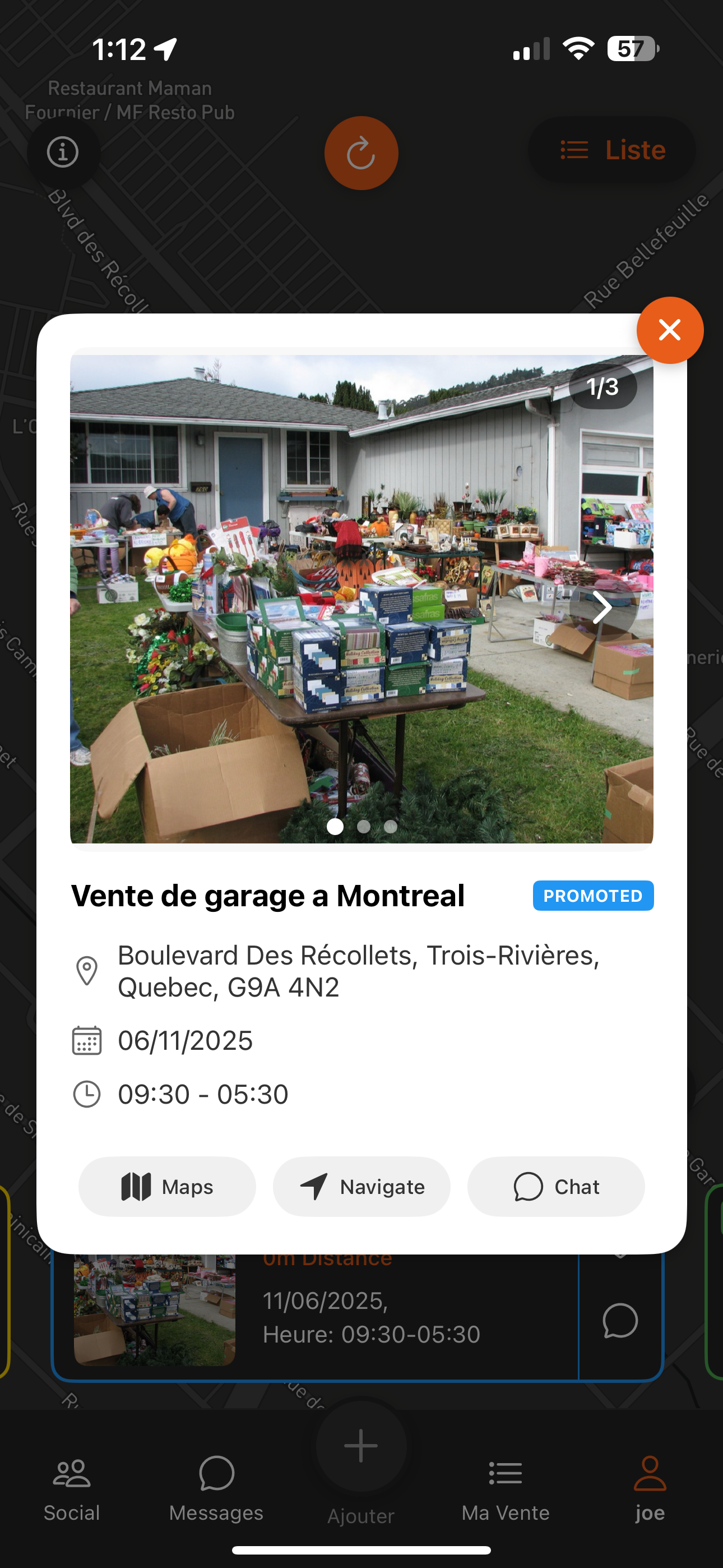
Marketplace can be safe if you follow the basic rules: never pay before seeing the product, meet in a public place, verify the seller's profile, and pay cash on the spot. The VentesDeGarage app offers a more secure alternative specifically dedicated to garage sales in Quebec.
Buy and sell with confidence
The VentesDeGarage app connects you with real garage sale sellers in your neighborhood. No scams, no fake profiles — just authentic garage sales near you.
Related articles
Last updated: April 18, 2026 | Written by the VentesDeGarage team
Reference source: Canadian Anti-Fraud Centre
📌 Liens utiles
- 🗺️ Carte interactive des ventes de garage — Trouvez les ventes près de chez vous en temps réel
- 📱 Télécharger l'app gratuite — iOS et Android
- 📖 Tous nos articles — Guides, calendriers et conseils
- 🏠 VentesDeGarage.ca — Accueil